A fence contractor in Mombasa, Dar es Salaam or Jeddah often sees the same thing: wire that looked bright and clean at installation shows red rust within two or three rainy seasons. Usually the steel is fine. The problem is the coating. Electro-galvanized wire and hot-dip galvanized wire can look alike on a quotation, but on a coastal site one can last several times longer than the other. The price per ton shows only part of the difference.
Two processes, very different zinc weights
Electro-galvanizing plates zinc onto the wire in an electrolytic bath. The layer is thin, even and shiny. Commercial electro-galvanized wire usually carries well under 50 g/m² of zinc, often much less. This suits indoor work and wire that ends up inside concrete, such as rebar tying wire.
Hot-dip galvanizing pulls the wire through molten zinc at around 450 °C. The zinc alloys with the steel surface and builds a much heavier layer. A heavy-coated hot-dip wire can carry five to ten times the zinc of an electro-galvanized wire of the same diameter.
Zinc protects steel by corroding first, so service life is roughly proportional to coating mass. As a guide, 7.14 g/m² of zinc equals about 1 µm of thickness.
How fast zinc disappears near the sea
ISO 9223 classifies atmospheres by corrosivity and gives first-year corrosion rates for zinc:
| Category | Typical environment | Zinc loss (µm per year) |
|---|---|---|
| C3 – medium | Urban inland, light industry | 0.7 – 2.1 |
| C4 – high | Industrial areas, coastal with moderate salt | 2.1 – 4.2 |
| C5 – very high | Coastline with high salt, humid industrial | 4.2 – 8.4 |
| CX – extreme | Splash zones, offshore, extreme humidity and salt | 8.4 – 25 |
Take a C5 seafront site losing around 6 µm a year. An electro-galvanized wire with 20 g/m² (about 3 µm) is bare in the first year. A hot-dip wire with 245 g/m² (about 34 µm) has a zinc reserve for several years more. These are first-year rates, and long-term losses usually slow down, so treat the arithmetic as a comparison rather than a guarantee. The ratio between the two wires is the point.
Reading the coating class on a specification
Two standards cover most fence wire orders from China. EN 10244-2 sets minimum zinc mass by class and wire diameter. Class A is the heaviest commercial class, and Class B is a medium coating:
| Wire diameter (mm) | Class A min. (g/m²) | Class B min. (g/m²) |
|---|---|---|
| 1.85 – 2.15 | 215 | 115 |
| 2.15 – 2.50 | 230 | 125 |
| 2.50 – 2.80 | 245 | 135 |
| 2.80 – 3.20 | 255 | 150 |
| 3.20 – 3.80 | 265 | 160 |
| 3.80 – 4.40 | 275 | 170 |
Each range includes its lower limit and excludes its upper one. In the US system, ASTM A641 uses Class 1 (light) to Class 3 (heavy) for wire. ASTM A392 covers chain-link fabric galvanized after weaving, at 1.2 oz/ft² (Class 1) or 2.0 oz/ft² (Class 2). For coastal work, ask for EN 10244-2 Class A, ASTM A641 Class 3, or A392 Class 2.
A quotation that says only "galvanized wire, 2.5 mm" does not tell you the coating. Before comparing prices, ask the supplier to state the process, the class and the minimum g/m². If you are converting gauges, our BWG wire gauge chart gives the millimetre equivalents.
Matching coating to fence component
- Chain-link mesh near the shore: heavy hot-dip, Class A, or PVC-coated over galvanized wire. The cut ends at the selvedge rust first, so knuckled or twisted selvedges with full-coated wire matter.
- Line and tension wire: heavy hot-dip. It carries load, and losing section to rust lets the whole fence sag.
- Tie wire for fixing mesh to posts: do not save money here. Electro-galvanized ties on a hot-dip fence become the first point of failure.
- Barbed and razor wire: hot-dip for strands, and check that the barbs are coated as well. Some cheap barbed wire uses electro-galvanized barbs.
- Gabions and sea walls: heavy hot-dip or zinc-aluminium (Zn95Al5, also covered by EN 10244-2), usually with a PVC sleeve on top.
- Inland compounds, more than about 10 km from the sea: Class B hot-dip is often enough. Electro-galvanized wire is still not a good outdoor choice.
Telling them apart when the goods arrive
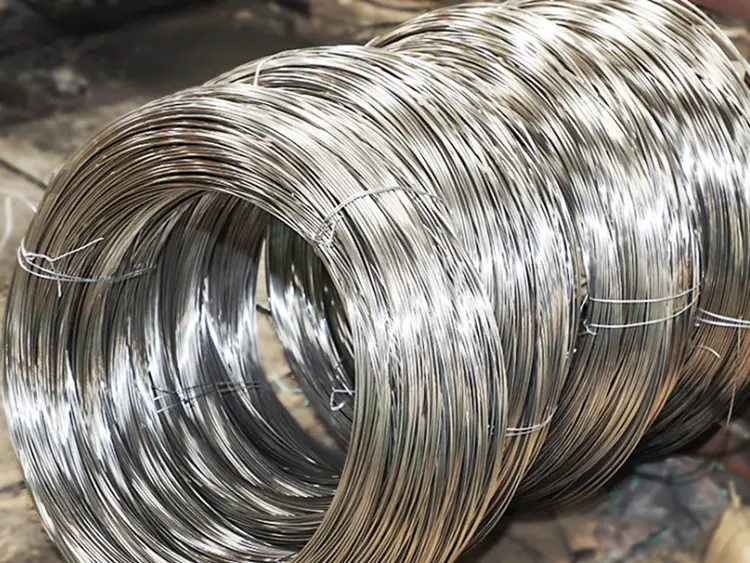
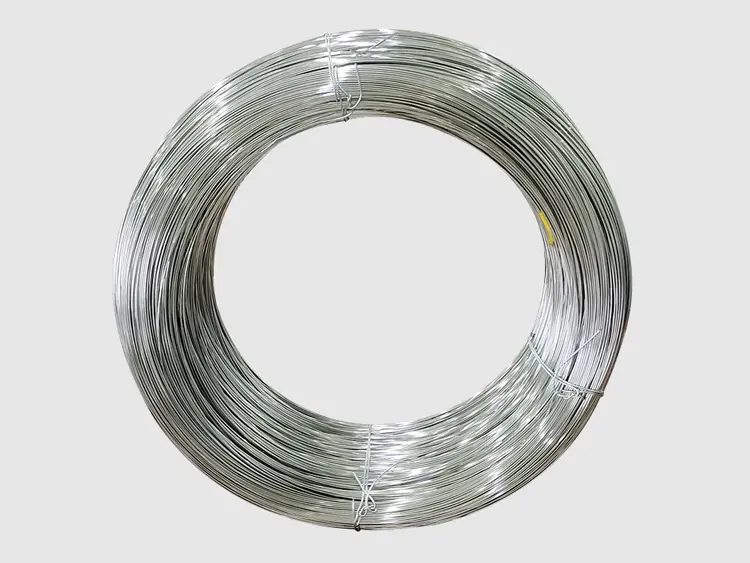
Appearance gives a first hint. Electro-galvanized wire is bright, smooth and almost mirror-like. Hot-dip wire is a duller silver, sometimes with a slightly uneven surface and small drips at coil ends. Appearance does not prove coating weight, though. For that:
- Ask for a test report showing zinc mass in g/m² for each lot, measured by the gravimetric (strip-and-weigh) method.
- Send a sample to a local lab for the same test. It is quick and inexpensive, and it is the only result that holds up in a dispute.
- Do a wrap test on site: coil the wire tightly around a bar of similar diameter. A poorly bonded hot-dip coating flakes or cracks. A good one stays on.
- Check the diameter. Measure with a micrometer at several points. Undersized wire with heavy zinc can still fail in tension.
Is the higher price worth it?
Heavy-coated hot-dip wire costs more per ton than electro-galvanized wire. The extra cost is mostly zinc and slower line speed. But wire is a small share of a fence's total cost once posts, concrete, labour and gates are counted. Replacing rusted mesh after three years costs all of that labour again. For any site within sight of the sea, heavy hot-dip or PVC-over-galvanized wire is the cheaper choice over the fence's life.
See our galvanized steel wire page for hot-dip and electro-galvanized options, and our wire rod in coils page if you draw your own wire. Both list available diameters, coil weights and packing.
Frequently asked questions
Can electro-galvanized wire be used for fencing near the sea?
It is not recommended, because its thin zinc layer can be consumed within the first year or two in a salty atmosphere; use heavy hot-dip or PVC-coated galvanized wire instead.
What zinc coating should I specify for coastal fence wire?
Specify EN 10244-2 Class A or ASTM A641 Class 3 for wire, and ASTM A392 Class 2 for chain-link fabric, and ask for the minimum g/m² on the quotation.
How can I tell hot-dip from electro-galvanized wire?
Electro-galvanized wire is bright and smooth while hot-dip is duller, but only a gravimetric coating test in g/m² proves the zinc weight.
Is PVC-coated wire better than hot-dip galvanized wire on the coast?
PVC over a galvanized core gives the longest life in salt air, as long as the PVC is not cut or damaged during installation.
Need a quotation?
Send us the size, grade, quantity and destination port — we reply with a CFR/CIF price, usually within 24 hours.