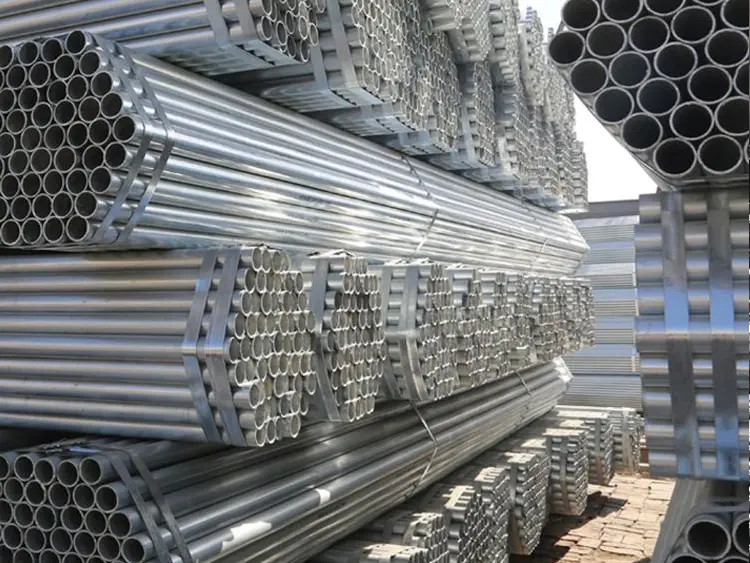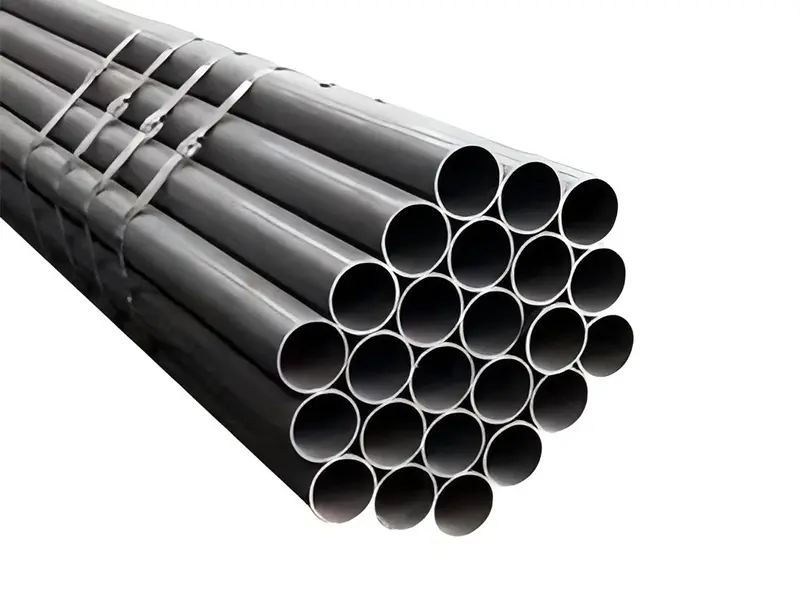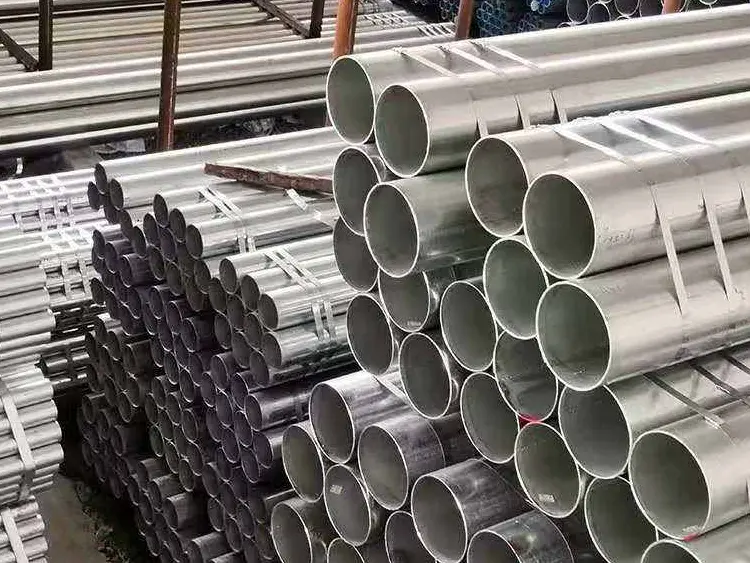
On an oil and gas site, "seamless only" is often written into a water-line enquiry out of habit, not because the service needs it. Modern high-frequency ERW pipe is a fully qualified product under API 5L and ASTM A53, and for most firewater, utility and low-pressure produced-water lines it does the job at a lower cost and with more uniform walls. Seamless earns its premium in a narrower set of cases. This guide sorts them out so you can quote, or challenge, a specification with confidence.
Two ways of making the same pipe
Seamless (SMLS) pipe starts as a solid round billet that is heated, pierced and rolled over a mandrel into a hollow. There is no longitudinal weld. Because the hole is formed by piercing, wall thickness can vary slightly around the circumference.
ERW pipe is formed from hot-rolled strip, curled into a tube and welded along its length by electric resistance. Current API 5L practice uses high-frequency welding (HFW), and the standard requires the full length of the weld seam to be inspected by ultrasonic or electromagnetic testing. Because the starting strip is rolled to tight gauge, ERW walls are usually more even than seamless.
The design code decides more than the mill process
The most useful single fact for a buyer: whether ERW is penalised depends on which piping code the line is designed to.
| Design code | Typical scope | Seamless joint factor | ERW joint factor |
|---|---|---|---|
| ASME B31.3 | Process and plant piping inside the fence | 1.00 | 0.85 |
| ASME B31.4 | Liquid pipelines, including produced-water and injection pipelines | 1.00 | 1.00 (API 5L ERW) |
| ASME B31.8 | Gas transmission and distribution pipelines | 1.00 | 1.00 (API 5L ERW) |
Under B31.3, an ERW pipe needs roughly 18% more pressure-design wall than seamless of the same grade (1 ÷ 0.85 ≈ 1.18). For small plant water lines that often means one schedule heavier, which can erase the price gap. Under the pipeline codes, ERW and seamless of the same grade and wall carry the same pressure rating, so ERW is the normal choice for long water pipelines.
Grades and standards you will see on the drawing
| Standard / grade | Manufacturing types allowed | Min. yield (MPa) | Min. tensile (MPa) |
|---|---|---|---|
| ASTM A53 Grade B | Seamless (Type S) or ERW (Type E) | 240 | 415 |
| ASTM A106 Grade B | Seamless only | 240 | 415 |
| API 5L Grade B | SMLS, ERW/HFW, SAW | 245 | 415 |
| API 5L X42 | SMLS, ERW/HFW, SAW | 290 | 415 |
| API 5L X52 | SMLS, ERW/HFW, SAW | 360 | 460 |
Note that A106 is a seamless, high-temperature standard. If a drawing calls for A106 on an ambient-temperature firewater line, ask whether A53 Grade B or API 5L Grade B would be acceptable; the strength is the same. For plain and galvanized water pipe to A53 and BS 1387, see our BS 1387 vs ASTM A53 comparison.
Where ERW is the sensible default
- Firewater ring mains and hydrant lines on onshore plants, depots and terminals, typically API 5L Grade B or A53 Grade B, often internally lined or galvanized.
- Utility, cooling and service water at moderate pressure and ambient temperature.
- Low-pressure produced-water transfer where the fluid is not classed as sour and a corrosion allowance or internal lining is specified.
- Long water pipelines designed to B31.4, where ERW has a joint factor of 1.00 and larger diameters are readily available.
When seamless is really needed
High-pressure injection and wellhead lines
Water-injection lines near the wellhead run at high pressure and often call for heavy walls in small diameters. Seamless mills cover heavy wall-to-diameter ratios that ERW lines cannot form, and B31.3 piping avoids the 0.85 factor.
Sour produced water
If the water contains H2S, the line falls under NACE MR0175 / ISO 15156 and pipe is ordered as API 5L PSL2 with Annex H. Both seamless and HFW can qualify, but the welded seam adds a zone that must meet the hardness limit (22 HRC for carbon steel) and pass HIC testing to NACE TM0284. Many operator specifications simply require seamless for sour service in smaller sizes. Follow the project specification here; do not substitute.
High temperature
Hot water and steam lines in process units are normally A106 seamless. Galvanized pipe should not be used in hot water service.
Older pipe and seam corrosion
Some older low-frequency ERW pipe suffered selective corrosion along the weld line in aggressive water. Modern HFW pipe with a heat-treated seam (mandatory for API 5L PSL2 welded pipe) is far less prone to this, but some clients remain cautious for corrosive produced water. Ask the end user before quoting ERW for that service.
Quick decision table
| Service | Usual choice |
|---|---|
| Firewater, utility water, onshore | ERW, API 5L Gr B or A53 Gr B |
| Water pipeline to B31.4 | ERW/HFW, API 5L PSL1 or PSL2 |
| Plant water piping to B31.3, small bore | Seamless often cheaper overall once the 0.85 factor is applied |
| High-pressure water injection | Seamless, API 5L PSL2 or A106 |
| Sour produced water | As project spec; PSL2 Annex H, often seamless |
| Hot water or steam | A106 seamless |
Buying checklist
- State the design code (B31.3, B31.4 or B31.8); it tells the mill and you whether ERW wall must be increased.
- Give the full specification: standard, grade, PSL level, any annex (H for sour, J for offshore), OD and wall or schedule.
- Write the manufacturing type explicitly: SMLS, or ERW/HFW. "Seamless or ERW" invites the cheapest option.
- Specify end finish (bevelled for welding, plain, or threaded and coupled), length (single or double random) and coating or lining.
- For ERW, require full-length weld seam NDT records; for all pipe, hydrostatic test records and an EN 10204 3.1 mill certificate showing heat number, chemistry and mechanicals.
- For sour service, add hardness and HIC test reports to the document list before ordering, not after shipment.
Weights per metre for galvanized water pipe are in our BS 1387 weight chart. For quotations, see our ERW and seamless steel pipe and seamless alloy pipe pages and send your line list with design code and service.
Frequently asked questions
Is ERW pipe acceptable for oil and gas water lines?
Yes, for most firewater, utility and pipeline water service ERW pipe to API 5L or ASTM A53 is acceptable, provided it meets the project specification and design code.
Why does ASME B31.3 penalise ERW pipe?
B31.3 gives ERW pipe a longitudinal joint factor of 0.85 against 1.00 for seamless, so ERW needs about 18% more pressure-design wall thickness.
Is seamless pipe required for sour produced water?
Not by NACE MR0175 itself, which allows qualified welded pipe, but many operator specifications require seamless in sour service, so the project specification governs.
Can A106 be replaced with A53 Grade B for firewater lines?
Often yes, since both have 240 MPa minimum yield and 415 MPa minimum tensile, but the substitution must be approved by the engineer because A106 is seamless-only.
Need a quotation?
Send us the size, grade, quantity and destination port — we reply with a CFR/CIF price, usually within 24 hours.