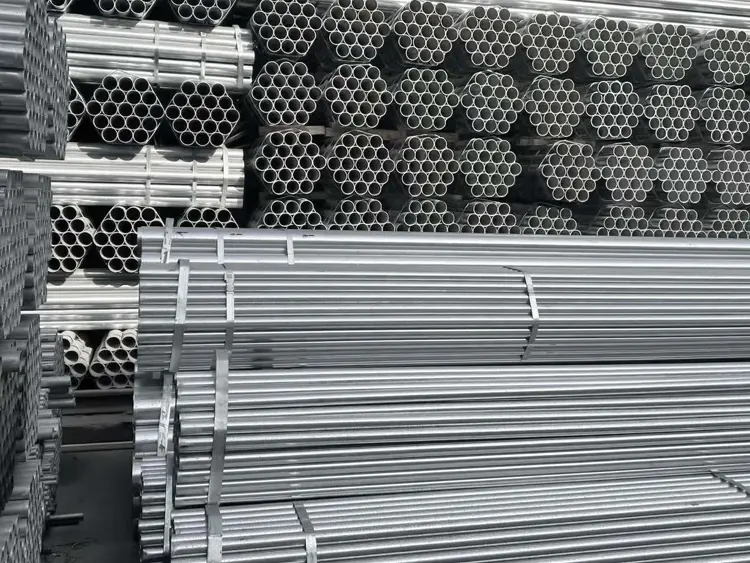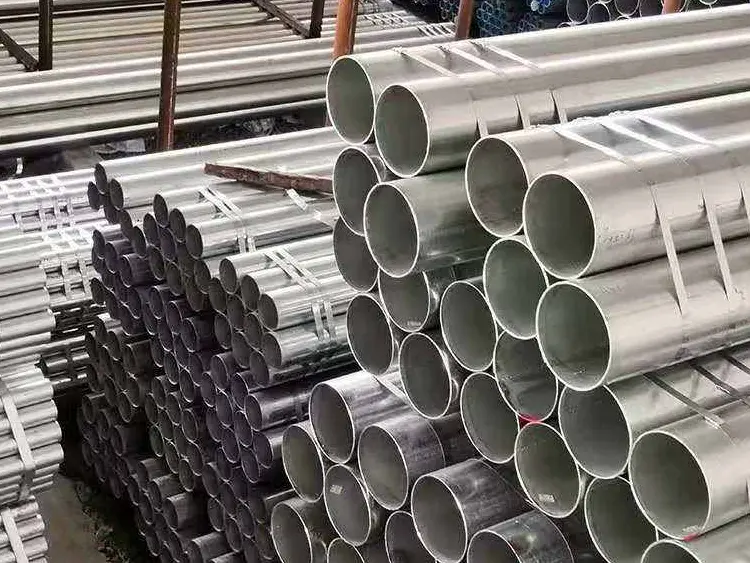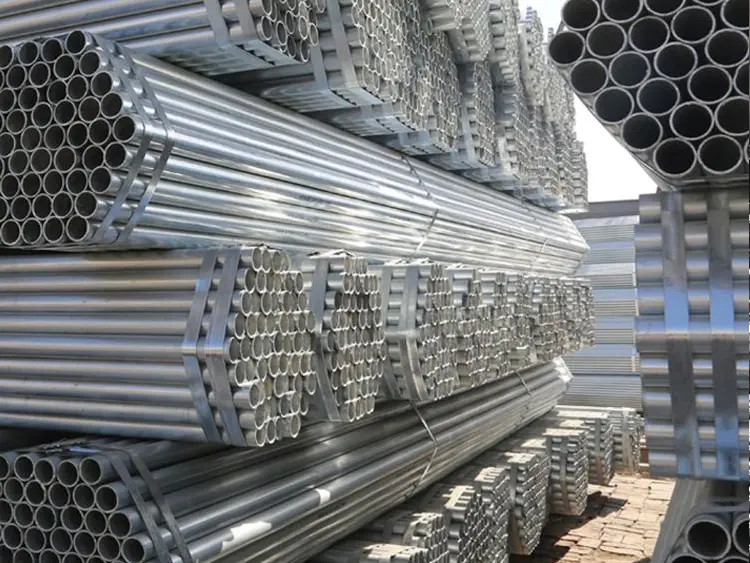
Two scaffold tubes can look identical on the yard: same 48.3 mm outside diameter, same silver zinc finish, same coupler fit. One weighs about 22 kg per 6 m length, the other about 26 kg. That difference is the gap between EN 39 Type 3 and Type 4, and it matters for safety, for your price per piece and for how many lengths you get in a container.
What EN 39 actually covers
EN 39 is the European standard for loose steel tubes used in tube-and-coupler scaffolding. It fixes the outside diameter at 48.3 mm, so the tube works with couplers made to EN 74, and defines two wall thicknesses called Type 3 and Type 4. The steel grade is S235GT, with a minimum yield strength of 235 N/mm². Tubes can be supplied black or hot-dip galvanized, and they may be welded or seamless.
Type 4 is the older, heavier tube that most contractors in former British markets know from BS 1139. Type 3 was added as a lighter option. Both are "EN 39", which is why a quotation that only says "EN 39 scaffold tube" is incomplete.
Type 3 and Type 4 side by side
| Item | Type 3 | Type 4 |
|---|---|---|
| Outside diameter | 48.3 mm | 48.3 mm |
| Nominal wall | 3.2 mm | 4.0 mm |
| Mass, black (kg/m) | 3.56 | 4.37 |
| 6.0 m length, black | about 21.4 kg | about 26.2 kg |
| 6.4 m (21 ft) length, black | about 22.8 kg | about 28.0 kg |
| Steel grade | S235GT | S235GT |
| Coupler compatibility | EN 74, 48.3 mm | EN 74, 48.3 mm |
Masses are calculated from nominal dimensions with steel density 7.85 g/cm³. Hot-dip galvanizing adds a few percent on top; our galvanized pipe weight chart shows how to estimate the zinc allowance for a given coating mass.
Strength is not just wall thickness
A 3.2 mm wall has roughly 20% less steel section than 4.0 mm, so a Type 3 tube carries less load as a standard (upright) and bends more as a ledger over the same span. A scaffold designed with Type 4 numbers cannot simply be built with Type 3 tube. Engineers designing to EN 12811-1 use the actual tube properties, and some design tables assume a higher yield strength for the thinner tube. If your client's drawings name a tube type, supply that type.
Do not mix them in one scaffold
The most common site problem is not choosing the wrong type, but mixing both. Because the outside diameter is the same, Type 3 and Type 4 fit the same couplers and look alike once galvanized. Problems that follow:
- A thin tube ends up in a heavily loaded position, such as a base standard or a loading bay.
- Inspectors cannot tell types apart quickly, so the whole structure becomes harder to sign off.
- Rental yards lose track of stock and price, because Type 3 is cheaper per piece.
Ask the supplier to stamp or stencil the tube type and manufacturer identification on each length, and keep the types in separate, clearly tagged bundles. Many rental companies also paint tube ends a different colour for each type.
Lookalikes that are not scaffold tube
48.3 mm is also the outside diameter of 1½" plumbing pipe, and BS 1387 / EN 10255 Medium 1½" has the same 3.2 mm wall as Type 3. It is still not a scaffold tube. Water pipe is made to a different standard, with different straightness, mechanical test and marking requirements, and is often threaded and socketed. Our BS 1387 vs ASTM A53 guide explains what those pipe standards control.
Chinese domestic scaffolding is another trap. Under the Chinese code JGJ 130, the common size is 48.3 × 3.6 mm in Q235 steel. It fits the same couplers but is neither Type 3 nor Type 4. If a quotation shows 3.5 or 3.6 mm wall, it is not an EN 39 tube, whatever the description says.
Which type should an importer stock?
| Customer | Usual choice | Reason |
|---|---|---|
| Contractors on projects with UK or EU consultants (Gulf, East Africa, Nigeria) | Type 4 | Specifications and temporary-works designs are usually written around 4.0 mm tube |
| Scaffold rental yards | Type 4, or Type 3 kept as a separate fleet | Heavier tube survives repeated handling, cutting and re-use longer |
| Light access, shop fitting, temporary fencing, event structures | Type 3 | Lower weight per piece and lower price, where a design allows it |
| Hardware shops selling loose lengths | Ask the end user | Buyers often do not know the type; label clearly to avoid misuse |
Buying checklist
- Standard and type in writing. "EN 39 Type 4, 48.3 × 4.0 mm, S235GT", not "scaffold pipe 48 mm".
- Finish. Black, painted, or hot-dip galvanized, with the coating standard and minimum coating mass stated. Pre-galvanized strip tube is a different product.
- Length. 6.0 m and 6.4 m (21 ft) are common, plus cut lengths such as 1.5, 2, 3 and 4 m. A 6.4 m tube will not fit a 20ft container; 6.0 m or shorter is safer.
- Ends. Square cut and deburred, so couplers and spigots seat properly.
- Marking. Type and maker identification on each tube.
- Documents. An EN 10204 3.1 mill test certificate showing chemistry, yield, tensile and elongation for the actual heat.
- Weight basis. Theoretical or actual weight, and whether zinc is included, so the piece count is agreed before loading.
For quick volume planning, 25 tons of black Type 4 in 6 m lengths is about 950 pieces; the same tonnage of Type 3 is about 1,170 pieces. Our galvanized round tube page lists the 48.3 mm sizes we supply; send the type, length and finish you need for a quotation.
Frequently asked questions
What is the wall thickness of EN 39 Type 3 and Type 4 scaffolding tube?
Both have a 48.3 mm outside diameter; Type 3 has a 3.2 mm wall and Type 4 has a 4.0 mm wall.
How much does a 6 m EN 39 Type 4 scaffold tube weigh?
About 26.2 kg black (4.37 kg/m × 6 m), slightly more after hot-dip galvanizing.
Can Type 3 and Type 4 tubes be used in the same scaffold?
They fit the same couplers, but they should not be mixed unless the scaffold design allows it, because Type 3 carries less load.
Is BS 1139 tube the same as EN 39?
The traditional BS 1139 tube, 48.3 × 4.0 mm, corresponds to EN 39 Type 4.
Need a quotation?
Send us the size, grade, quantity and destination port — we reply with a CFR/CIF price, usually within 24 hours.