315 MPa or 345 MPa. That is the whole headline difference between ASTM A500 Grade B and Grade C square tube, and it is enough to change member sizes on a warehouse roof, a mezzanine or a canopy frame. Structural engineers in the Gulf, East Africa and Southeast Asia often write "A500 Grade B or C" on drawings without explaining which one they actually designed for. If you are the importer or contractor placing the order, this is what you need to know before you sign the purchase contract.
What ASTM A500 covers
ASTM A500 is the American specification for cold-formed welded and seamless carbon steel structural tubing in round, square, rectangular and special shapes. In practice almost all A500 hollow sections from China are ERW (electric resistance welded) and formed cold from hot-rolled strip. The standard is written for structural use: columns, trusses, purlins, frames and supports. It is not a pressure-pipe standard, so it says nothing about hydrostatic testing or threads. For water and gas lines, see our comparison of BS 1387 and ASTM A53 pipe instead.
A500 has four grades: A, B, C and D. Grade A is rarely specified for new work, and Grade D requires heat treatment, so importers deal mostly with B and C.
The numbers side by side
One detail catches many buyers: A500 gives different strength values for round tube and for shaped (square and rectangular) tube of the same grade. Always read the right column.
| Property (minimum) | Grade B round | Grade B square / rect. | Grade C round | Grade C square / rect. |
|---|---|---|---|---|
| Yield strength | 290 MPa (42 ksi) | 315 MPa (46 ksi) | 315 MPa (46 ksi) | 345 MPa (50 ksi) |
| Tensile strength | 400 MPa (58 ksi) | 400 MPa (58 ksi) | 425 MPa (62 ksi) | 425 MPa (62 ksi) |
| Elongation in 50 mm* | 23% | 23% | 21% | 21% |
*For wall thickness of 3.05 mm (0.120 in) and above; thinner walls have lower minimum elongation under the standard.
On chemistry, the heat analysis limits are close. Grade B allows up to 0.26% carbon and Grade C up to 0.23%, with phosphorus and sulphur each capped at 0.035% for both. The slightly lower carbon on Grade C helps weldability, which matters for site-welded connections.
Why Grade C often costs the same
A Grade C tube meets every minimum of Grade B: higher yield, higher tensile, lower carbon. Because of this, many mills produce to Grade C and dual-certify the material as "ASTM A500 Grade B/C" on the mill test certificate. For common square sizes, the price gap between B and C is often small or zero, because the strip grade is the same. Where there is a premium, it usually comes from a mill that has to source a stronger coil specifically for your order.
So the practical question is less "B or C?" and more "is the certificate showing test results that actually reach the Grade C minimums?" Check the yield and tensile figures on the certificate against the table above, not just the grade name printed at the top.
When the engineer really needs Grade C
- The design used 345 MPa (50 ksi). If the calculation sheet or the steel notes on the drawing show Fy = 50 ksi or 345 MPa, Grade B is a substitution that reduces capacity by around 9%. That is not acceptable without the engineer's written approval.
- Long-span roofs and portal frames, where tube sizes were chosen at the limit to save weight.
- Replacing an EN 10219 S355 design. Grade C (345 MPa) is the closest A500 grade to S355J2H (355 MPa). It is close but not identical, so the engineer must confirm the swap.
For fences, gates, balustrades, sign frames, furniture and light sheds, strength is rarely the controlling factor. Grade B, or even a GB/T 6728 Q235 tube, is normally fine and may be easier to source in galvanized form.
Things A500 does not control
Buyers sometimes assume the grade covers everything. It does not:
- Wall tolerance. A500 allows the wall to be up to 10% under nominal. US steel design practice (AISC 360) therefore uses 0.93 × nominal wall for A500 sections in calculations. If you need tighter walls, ASTM A1085 is the stricter alternative.
- Impact toughness. There is no mandatory Charpy test in A500. If the project specifies impact testing, add it to the purchase order as a supplementary requirement.
- Coating. A500 is a black-steel standard. For outdoor frames, specify hot-dip galvanizing after fabrication or buy hot-dip galvanized square tube and state the required zinc coating in the order.
Purchase order checklist
| Item | What to write |
|---|---|
| Standard and grade | ASTM A500 Grade C (or Grade B/C dual certified) |
| Shape and size | Outside dimensions × wall, e.g. 100 × 100 × 4.0 mm |
| Length | Usually 6 m or 12 m; 5.8 m fits 20ft containers |
| Surface | Black oiled, painted, pre-galvanized or hot-dip galvanized |
| Documents | Mill test certificate to EN 10204 3.1 with actual yield, tensile and chemistry |
| Marking | Standard, grade, size and heat number on each tube or bundle |
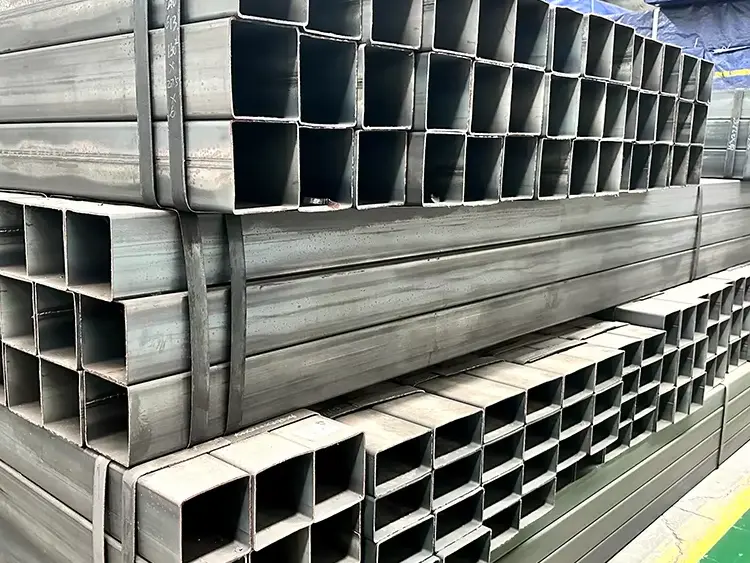
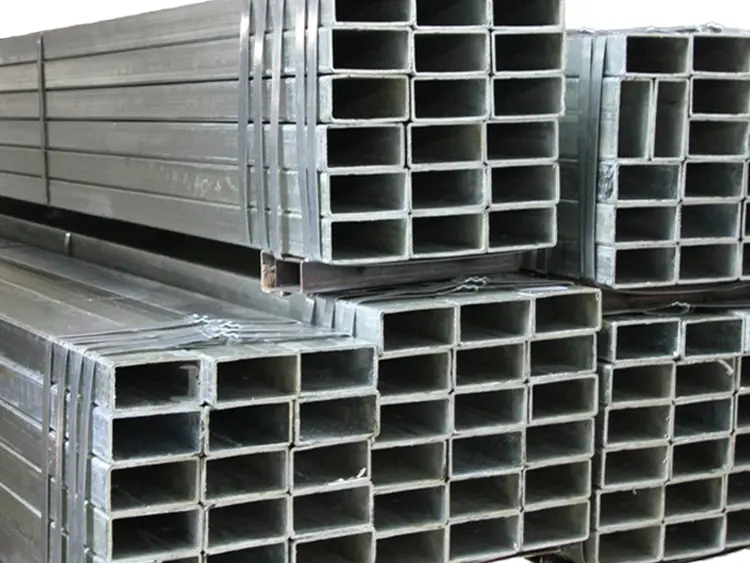
For shipping, square tube is packed in hexagonal or square bundles strapped with steel bands. A 20ft container is about 5.9 m long inside, so order 5.8 m lengths for 20ft boxes; 6 m and 11.8 m lengths go in 40ft containers, and full 12 m lengths usually ship break-bulk. Ask the supplier for the bundle weight so your yard can plan crane capacity. Our galvanized square tube page lists the common sizes we supply.
Frequently asked questions
Can I use ASTM A500 Grade B instead of Grade C?
Only if the engineer designed for 315 MPa (46 ksi) or approves the change in writing; Grade B square tube has about 9% lower minimum yield than Grade C.
What does "A500 Grade B/C" on a certificate mean?
It means the tube is dual certified: the test results meet the minimums of both grades, so it can be used where either Grade B or Grade C is specified.
Is ASTM A500 Grade C equal to S355?
Not exactly. Grade C square tube has a 345 MPa minimum yield against 355 MPa for EN 10219 S355J2H, and A500 has no mandatory impact test, so an engineer must approve the substitution.
Can ASTM A500 tube be used for water pipe?
No. A500 is a structural standard with no pressure test or thread requirements; use ASTM A53 or BS 1387 / EN 10255 pipe for water service.
Need a quotation?
Send us the size, grade, quantity and destination port — we reply with a CFR/CIF price, usually within 24 hours.